



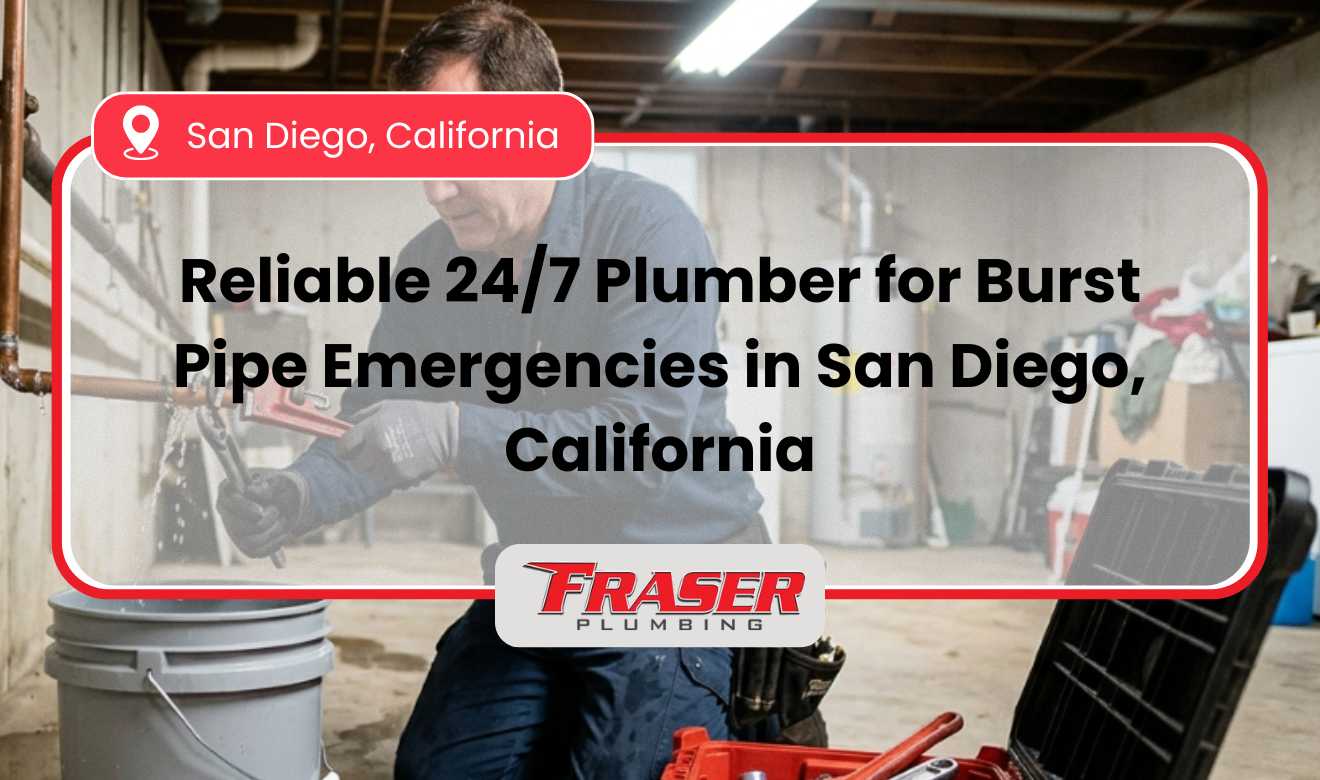
Reliable 24/7 Plumber for Burst Pipe Emergencies in San Diego, California
Executive Summary: A burst-pipe emergency in San Diego is definitively resolved by stopping pressurized water immediately at the correct shutoff, then performing a code-compliant section repair with controlled repressurization and meter-based verification to confirm zero ongoing flow. The fastest damage reduction comes from rapid isolation, instrument-assisted leak location when the break is hidden, and documented system checks before restoration begins.
- Shutoff Control First: The most important action is shutting off water at the nearest effective valve (fixture stop, unit isolation, house main, or meter-side valve) and confirming the meter indicates no continued flow.
- Locate and Isolate Precisely: When the break is not visible, pressure testing plus acoustic and thermal tools help identify the failure point and limit demolition while preventing spread into slabs or adjacent condo units.
- Repair to Code and Verify Stability: A proper fix replaces the compromised section, addresses supports/strapping and corrosion-prone transitions, and finishes with gradual repressurization and final confirmation of stable pressure and no hidden leak activity.
A 24/7 plumber for burst pipe San Diego is an emergency plumbing service that responds at any hour to stop active leaks, isolate damaged lines, and prevent water damage in San Diego County. A true burst-pipe response starts with fast shutoff control at the house main, a meter-side valve, or a unit valve in condos near Mission Valley, Downtown, and North Park where shared walls and stacked piping can spread water quickly. Technicians commonly locate the break in copper, PEX, or galvanized lines using pressure testing, acoustic leak detection, and thermal imaging when water is migrating under slab foundations in neighborhoods like Clairemont and Mira Mesa. Repairs often require a short, code-compliant section replacement, new shutoff installation, and proper pipe strapping, followed by a controlled repressurization to confirm there is no secondary failure. In older coastal homes in Ocean Beach and Point Loma, salt air and aging fittings can accelerate pinhole leaks that turn into sudden line splits, so emergency work may include corrosion assessment and dielectric protection at transitions. For homes with fire-sprinkler or recirculation loops, crews also verify backflow protection and check for continuous flow at the water meter to ensure the leak is fully contained before restoration begins.
What counts as a burst-pipe emergency in San Diego homes and condos
A burst pipe is treated as an emergency when pressurized supply water is actively escaping or when water migration threatens structural materials, electrical systems, or adjacent units. In San Diego’s multi-unit buildings and slab-on-grade neighborhoods, “small” failures can escalate fast because water travels through framing bays and under flooring.
Common real-world burst-pipe scenarios that require immediate response include:
- Active spraying or flowing from a supply line (hot or cold) in walls, ceilings, garages, or exterior risers.
- Ceiling bubbling, sagging drywall, or water at recessed lights (electrical hazard and potential collapse risk).
- Continuous water meter movement with all fixtures off, indicating an uncontrolled leak on the customer side of the meter.
- Sudden pressure drop at multiple fixtures, especially when paired with water sounds in walls.
- Flooding in condos/townhomes where unit isolation is urgent to prevent damage to neighbors and common areas.
San Diego properties frequently contain mixed materials—copper branches tied into PEX repairs or galvanized sections—so the emergency assessment must confirm not only the failure point but also whether adjacent piping is compromised by corrosion, poor supports, or excessive pressure.
Immediate actions to take before the plumber arrives
Fast shutoff and basic mitigation reduce water damage more than any later repair step. The safest approach is to stop water flow first, then protect people and property.
Use this priority checklist:
- Shut off water at the closest effective valve.
- Use the fixture stop (toilet angle stop, sink stop) if the leak is localized.
- If the leak is inside a wall/ceiling or unknown, shut off the home’s main valve (often at the hose bib/front wall) or the meter-side valve at the curb box.
- In condos, shut off the unit isolation valve if present and notify building management immediately.
- Shut off electricity to affected areas if water is near outlets, lighting, or panel equipment. If you cannot do this safely, keep clear and wait for help.
- Relieve pressure by opening a cold faucet at the lowest level after shutoff.
- Contain and document:
- Move valuables and place towels/buckets; avoid using extension cords in wet areas.
- Take photos/video for insurance and property management records.
- Avoid “quick fixes” that can worsen the break, such as over-tightening fittings on copper or wrapping high-pressure sprays with tape without depressurizing.
If the affected line supplies a water heater, do not continue heating a dry or partially supplied tank; shut the heater off at its control or breaker until the system is stable.
How a 24/7 burst-pipe response is typically performed (step-by-step)
Emergency plumbing for burst pipes follows a controlled sequence: stop flow, locate, isolate, repair to code, and verify under pressure. This process is designed to prevent secondary failures and reduce downstream restoration costs.
A standard field workflow in San Diego County often includes:
- Site safety and shutoff confirmation
- Confirm the correct valve is off and that flow has stopped at the meter.
- Identify electrical hazards and saturated building materials.
- Leak localization
- Visual inspection of accessible piping and fittings.
- Pressure testing to confirm supply-side failure vs. fixture drain issues.
- Acoustic detection for hidden pressurized leaks behind finishes.
- Thermal imaging to map hot-water migration in walls or slab zones.
- Isolation strategy
- Isolate the smallest practical section to restore partial service where possible.
- In stacked condo plumbing, confirm whether the leak is in a common riser or unit branch.
- Repair or replace damaged section
- Replace split copper/PEX/galvanized segments with properly rated materials and fittings.
- Add or replace a local shutoff valve where code and access allow, to improve future response time.
- Correct support/strapping to reduce vibration and stress (a frequent contributor to joint fatigue).
- Controlled repressurization and verification
- Bring pressure back gradually while observing joints, stops, and transitions.
- Confirm no continuous flow at the water meter once fixtures are off.
- Verify hot-water recirculation loops and fire-sprinkler related piping are not impacted, where applicable.
Because repairs in finished spaces can require opening drywall or cabinets, crews typically focus first on making the plumbing system safe and stable, then coordinate access for permanent restoration.
Materials and failure patterns seen in San Diego: copper, PEX, and galvanized
Each pipe material fails in a predictable way, so technicians tailor detection and repair methods accordingly. Identifying the “why” behind the split is critical to prevent repeat events on the next weak joint.
Typical patterns include:
- Copper
- Pinhole leaks that evolve into splits near fittings or along work-hardened sections.
- Accelerated corrosion in coastal exposure zones and at dissimilar-metal transitions.
- Improperly supported runs that flex under pressure changes.
- PEX
- Failure at crimp/clamp connections if improperly installed or stressed by tight bends.
- Damage from UV exposure when installed where sunlight reaches the pipe.
- Localized cuts or punctures during remodeling.
- Galvanized steel
- Internal scaling that restricts flow and creates uneven pressure/velocity.
- Threaded joint leaks and wall thinning that can rupture under normal operating pressure.
- Frequent need for broader replacement rather than spot repair due to system-wide deterioration.
If you’re comparing long-term options after an emergency repair—especially in older housing stock—understanding how copper systems are designed and maintained can help clarify next steps; see the role of copper pipes in modern plumbing systems.
San Diego compliance checkpoints: permits, shutoffs, and cross-connection protection
Emergency work still has to respect California and local requirements for potable water safety and permitted alterations. The most important compliance focus areas are proper materials, correct valve installation, and prevention of backflow/cross-connections.
Key checkpoints that reputable plumbers follow:
- Potable-water materials and fittings must be listed for domestic water service and installed per manufacturer instructions.
- Pressure regulation may be evaluated if a home shows signs of excessive static pressure (which contributes to burst events and fixture failures).
- Backflow protection must not be bypassed or compromised during emergency reroutes—especially for irrigation tie-ins, fire lines, or commercial connections.
- Permits and inspections may be required when work exceeds a minor repair (for example, replacing significant piping lengths, relocating mains, or performing repipes). In San Diego jurisdictions, permitting is administered through the local Authority Having Jurisdiction (AHJ), and requirements vary by scope.
When a burst pipe involves cross-connection risk (irrigation, commercial equipment, multi-tenant buildings), scheduling backflow devices service is a practical step to confirm the potable system remains protected after the repair.
Core metrics technicians verify before leaving the property
Verification is not optional: the job is incomplete until the system holds pressure and shows no hidden flow. These checks are measurable and repeatable, which is why they are used in professional emergency protocols.
| Feature / Metric | Specifications | Local Guidelines |
|---|---|---|
| Water shutoff effectiveness | No flow at fixtures; meter flow indicator stops after fixtures are off | In condos/HOAs, confirm unit isolation and notify building management to reduce common-area claims |
| Pressure stability after repair | System holds normal operating pressure without drift or audible leak | If repeat failures occur, evaluate need for pressure regulation and condition of older piping runs common in coastal and mid-century neighborhoods |
| Joint and transition integrity | No seepage at couplings, valves, dielectric unions, or adapters | Dissimilar-metal transitions should be protected to reduce galvanic corrosion potential |
| Thermal/moisture confirmation | No continuing heat signature or moisture spread after repressurization | Slab-on-grade areas (e.g., Clairemont/Mira Mesa patterns) may require follow-up moisture mapping before closing surfaces |
| Backflow/cross-connection risk check | No bypassed devices; valves restored to correct orientation | Irrigation and commercial setups should maintain backflow protection per local water purveyor rules |
When a “simple repair” should escalate to leak detection, slab work, or repiping
Some burst-pipe calls are symptoms of a broader failure pattern, not one isolated crack. Escalating to advanced diagnostics or replacement is justified when objective indicators show the system is at risk.
Escalate beyond a spot fix if you see:
- Repeated leaks within months on the same branch or in the same pressure zone.
- Evidence of slab migration: warm spots on flooring, unexplained humidity, or water emerging at slab edges.
- Galvanized piping still in service with widespread restriction and corrosion at threaded joints.
- Multiple pinholes on copper or green/blue staining patterns that indicate ongoing corrosion activity.
- High pressure symptoms: frequent angle-stop failures, running toilets after fill, banging pipes, or recurring supply hose ruptures.
If water is suspected under concrete, a targeted detection-and-repair plan is usually more cost-controlled than repeated openings; in those situations, professional slab leak repair support can help narrow scope and reduce unnecessary demolition.
Water damage mitigation coordination after the leak is stopped
Once the plumbing is stable, drying and contamination control become the priority to prevent mold and material failure. San Diego’s varied microclimates still allow rapid microbial growth in wet drywall and insulation if drying is delayed.
Recommended next steps after shutoff and repair:
- Remove standing water and begin dehumidification quickly; porous materials may need removal depending on saturation.
- Document moisture conditions (photos and readings if available) for insurance and property records.
- Check adjacent units in condos/townhomes; water often travels laterally before it becomes visible.
- Do not seal wet cavities behind new drywall or paint; trapped moisture drives future damage.
Where drying and rebuild must be coordinated immediately, arranging a water damage restoration service keeps mitigation aligned with plumbing verification so materials are not closed up before the system is proven tight.
How to choose an emergency plumber for burst pipes (proof-based criteria)
The right choice is the provider who can demonstrate safe shutoff control, correct diagnostics, and code-aligned repairs—not just fast arrival. In a burst event, workmanship errors can create secondary failures when the line is repressurized.
Use these objective screening points during dispatch:
- Licensing and scope clarity: confirm the contractor is licensed for plumbing work in California and can pull permits when required for the scope.
- Leak location method: ask whether they use pressure testing and instrument-based detection when the break is not visible.
- Repair standards: confirm they replace compromised sections (not just patch) and address supports/strapping.
- System verification: ask if they confirm meter flow stops and perform a controlled repressurization.
- Multi-unit coordination: in HOAs/condos, ensure they can work with building shutoffs and document isolation steps.
For readers who want a broader baseline on how plumbing systems are structured and why certain emergency steps matter, a straightforward reference is plumbing.
Rapid recap: stopping damage first, then fixing the system permanently
The most effective burst-pipe outcome in San Diego comes from a strict sequence: shut off, verify, repair to potable-water standards, then confirm zero flow and stable pressure. This reduces property loss in dense neighborhoods, condo stacks, and slab foundations where water spreads invisibly.
Keep these takeaways as your action plan:
- Shut off water fast at the nearest effective valve; confirm at the meter if possible.
- Protect safety by managing electrical risk and preventing slips/falls.
- Use diagnostic tools when the leak is hidden—pressure testing, acoustic methods, and thermal imaging reduce unnecessary demolition.
- Demand verification: controlled repressurization and meter confirmation are the clearest proof the leak is contained.
- Plan prevention if failures repeat: evaluate pressure regulation, corrosion at transitions, and whether sections of old piping justify replacement instead of ongoing patches.
Frequently Asked Questions
Stop the Water Now—Before a “Small Leak” Turns Into a Major Loss
A burst pipe doesn’t wait for business hours—and neither does the damage. In San Diego homes and condos, water can race through walls, ceilings, and slab areas fast, soaking insulation, swelling drywall, threatening electrical, and spreading into neighboring units before you even see the worst of it.
Trying to DIY a burst-pipe situation (or hiring someone who’s “available” but not equipped) is where homeowners get hit twice: first by the water, then by the comeback. Overtightened fittings, the wrong repair method for copper vs. PEX vs. galvanized, missed secondary weak points, and repressurizing too fast can trigger another failure the moment the line comes back on. And if the leak is hidden, guessing where to open walls can turn a targeted repair into unnecessary demolition—while the real break keeps migrating under floors or across shared condo plumbing.
A true 24/7 burst-pipe response is about control and verification: shutting the correct valve fast, isolating only what’s needed, using pressure testing and professional detection when the break isn’t visible, making a code-compliant repair with proper supports and transitions, then confirming meter flow stops and pressure holds so you don’t get surprised an hour later.
If you’re dealing with active leaking, ceiling bubbling, a sudden pressure drop, or unexplained meter movement, don’t gamble with your property (or your neighbor’s). Call a local emergency plumber who can stop the damage immediately—and prove the system is stable before they leave.
Related Posts
Shower Drain Cleaning Service in San Diego, CA: Fast, Professional Clog Removal and Odor Control
Executive Summary A shower drain cleaning service in San Diego definitively resolves slow drainage and…

Bathroom Sink Drain Cleaning in San Diego, CA: Costs, Best Methods, and When to Call a Plumber
Executive Summary Bathroom sink drain cleaning in San Diego is most reliably resolved by mechanically…