Key Takeaways
Trenchless sewer repair in San Diego typically uses CIPP pipe lining or pipe bursting to restore a damaged sewer lateral with limited surface disruption compared with open trench replacement, but it still requires inspection, cleaning, and the right access. The best method depends on what the camera inspection shows—because issues like collapses, severe deformation, or bellies may require excavation or full replacement to correct the root cause.
- Confirm candidacy with inspection and preparation: Contractors typically start with a sewer camera inspection, often followed by cleaning and locating, to identify defect types, verify the line is passable, and plan access pits precisely.
- Match the method to the failure mode: CIPP lining is commonly used when the host pipe is continuous and can be cleaned for cracks, leaking joints, and root intrusion, while pipe bursting is considered when the existing line is too deteriorated to rehabilitate reliably.
- Recognize trenchless limitations and cost drivers: Trenchless work is not “no-dig,” and factors like access points, depth, cleaning difficulty, branch reinstatement after lining, and whether the line has bellies or severe misalignment can affect feasibility and project cost.
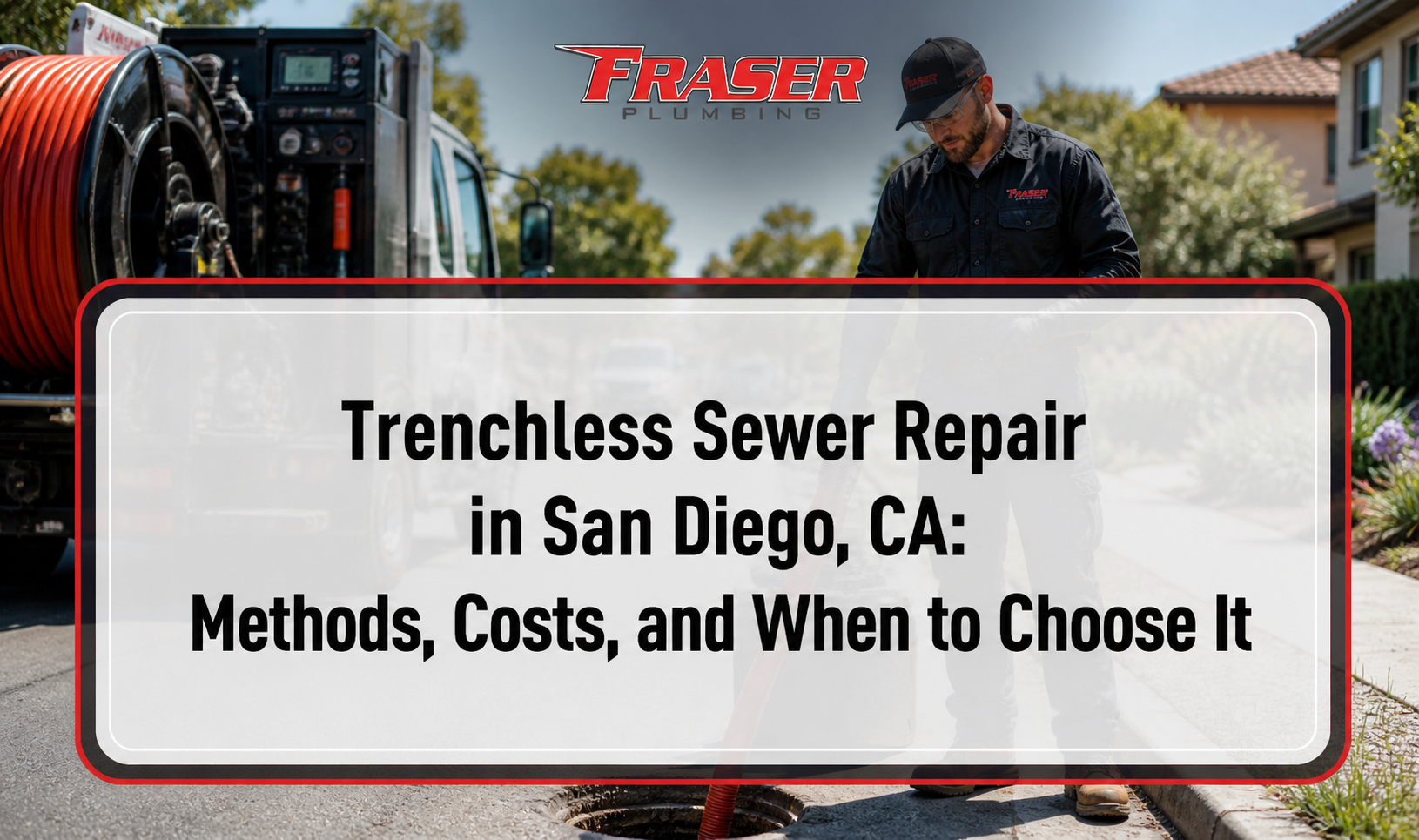
Trenchless sewer repair San Diego homeowners and property managers often choose uses pipe lining or pipe bursting to restore a damaged sewer lateral without excavating a long trench across yards, driveways, or hardscapes. These methods are commonly used when a sewer line has cracks, root intrusion, offsets, or corrosion but still has a route that can be rehabilitated.
In San Diego, trenchless options can reduce surface disruption compared with traditional dig-and-replace, but they still require a proper diagnosis, typically starting with a sewer camera inspection and, when needed, locating equipment to confirm depth and alignment. Suitability depends on pipe material, diameter, access points like cleanouts, and whether the line has collapsed or is severely misaligned.
This guide explains the main trenchless methods, what typically drives project cost, and how to decide when trenchless repair makes sense versus full replacement based on the condition of the existing sewer line and site constraints.
What “Trenchless” Means for Sewer Laterals in San Diego
Trenchless sewer work restores or replaces an underground sewer lateral using existing access points and small excavations, rather than opening a continuous trench from the house to the street.
In most residential and light commercial situations, the lateral is the private sewer line that carries wastewater from a building to the public main (typically near the street). Trenchless sewer repair San Diego property owners consider is usually selected to limit disruption to landscaping, concrete, pavers, or tight side yards—while still addressing defects like cracking, root intrusion, or worn-out materials.
It’s important to know that “trenchless” does not mean “no digging.” Small pits are often needed at cleanouts, transitions, or connection points, and access may be required near the property line. The advantage is that the disturbed areas are typically limited to strategic points instead of a full-length excavation.
Common Sewer Line Problems Trenchless Methods Can Fix
Trenchless methods work best when the pipe’s route is still passable and can be cleaned, measured, and prepared for rehabilitation or replacement.
Before selecting a method, a contractor typically confirms what is actually failing: the pipe wall, the joints, the slope, the alignment, or a combination. Some defects are ideal for lining; others require bursting or a targeted excavation.
- Root intrusion: Roots enter through joints or cracks, causing recurring backups and snagging debris.
- Cracks and fractures: Often caused by age, ground movement, or localized loading.
- Corrosion or wear: More common with certain older materials, resulting in rough interiors and reduced flow capacity.
- Offset joints / minor misalignment: Small steps between pipe sections can catch waste and accelerate clogs.
- Separated joints or missing sections: May require replacement rather than lining, depending on severity.
- Bellies (low spots): Standing water indicates slope problems; lining won’t correct a belly if the pipe’s grade is wrong.
If the camera shows a full collapse, severe deformation, or the line can’t be opened and cleaned, trenchless rehabilitation may not be feasible without at least some excavation to re-establish a pathway.
How Contractors Confirm You’re a Candidate: Inspection, Cleaning, and Locating
Trenchless project planning usually begins with a camera inspection and line cleaning to verify pipe condition, measure key points, and confirm the repair approach.
Sewer camera inspection: what it answers
A video inspection identifies the defect type, distance to failures, and whether the line is continuous enough to rehabilitate.
Camera work typically documents:
- Where roots enter and whether intrusion is localized or widespread
- Cracks, holes, and deteriorated joints
- Pipe material transitions (for example, cast iron to ABS/PVC)
- Offsets, sags, or evidence of standing water
- Whether the camera can reach the connection point (a key feasibility factor for lining)
When you need documentation to plan a repair or confirm line condition before purchase or renovation, a sewer camera video inspection is often the most direct way to avoid guesswork.
Cleaning: why it’s often required before lining
Most lining systems require a clean, open pipe interior so the new liner can bond and cure correctly.
Contractors may use mechanical cutting for roots and scale, or high-pressure jetting depending on pipe condition. Cleaning also helps reveal defects that were hidden behind buildup, which can change the recommended repair plan.
- Root cutting can restore temporary flow but may not stop regrowth if joints remain open.
- Jetting can remove grease and debris, but may not be appropriate for severely fragile pipe without careful evaluation.
Locating and depth verification
Locating tools help confirm depth, route, and key turn points so access pits can be planned precisely.
This step matters in San Diego where laterals may run under slabs, mature landscaping, retaining walls, or hardscape. Confirming depth and alignment reduces the risk of digging in the wrong area or missing a critical transition point.
Main Trenchless Methods Used in San Diego
Most trenchless sewer repair approaches fall into two categories: rehabilitating the existing pipe (lining) or replacing it along the same path (bursting).
Cured-in-place pipe (CIPP) lining
CIPP lining creates a “pipe within a pipe” by inserting a resin-saturated liner that cures into a new continuous interior wall.
Lining is commonly chosen when the existing pipe is still mostly intact but leaking at joints, cracked, or invaded by roots. Because it follows the existing alignment, it cannot correct major slope problems, and it requires the pipe to be open enough for insertion and inflation.
- Best for: cracks, minor joint defects, root intrusion after proper cleaning, corrosion/roughness
- Not ideal for: major bellies, severe deformation, collapsed sections that block access
- Access needs: typically through cleanouts or small excavations at entry/exit points
After installation, reinstating branch connections (where smaller lines tie in) may be necessary using specialized cutting tools. For properties with multiple fixtures and branches, that step can influence project complexity and scheduling.
Pipe bursting (full replacement along the existing route)
Pipe bursting replaces the old pipe by pulling a bursting head through it, fracturing the existing line outward while dragging in a new pipe behind.
This method is often selected when the existing pipe is too deteriorated to line reliably, or when upsizing is needed (where feasible). It still follows the approximate existing alignment, but requires pits at the start and end and enough surrounding space to allow the old pipe to fracture without unacceptable risk to nearby utilities or structures.
- Best for: severely deteriorated lines, repeated failures, sections that are too compromised for lining
- Limitations: careful evaluation needed near other underground utilities; tight clearances can rule it out
- Access needs: entry and reception pits, plus space to stage pulling equipment
Spot repairs and sectional lining
When damage is localized, a targeted excavation or a sectional liner can address a specific failure without rehabilitating the entire line.
Spot solutions can be cost-effective for a single cracked joint or short damaged area. However, they may be less effective if the rest of the pipe is near end-of-life or if multiple defects are present along the run.
- Targeted dig-and-repair: replace only the failed section
- Sectional liner: line a short portion, often used for a single crack or joint failure
- Hybrid approach: excavate a collapsed portion, then line the remaining length
Trenchless vs. Traditional Replacement: Practical Comparison
The best method depends on pipe condition, access, and what you need to protect on the surface (concrete, landscaping, walls), not just a preference for “no-dig.”
| Method | What It Typically Does Best | When It May Not Be a Fit |
|---|---|---|
| CIPP pipe lining | Seals cracks and leaking joints while minimizing surface disruption; creates a continuous interior pipe wall. | Collapsed sections, severe deformation, or significant bellies that require regrading. |
| Pipe bursting | Full replacement along the same route; useful when the host pipe is too deteriorated to rehabilitate. | Tight clearances near other utilities/structures; routes where bursting could disturb adjacent lines. |
| Spot repair (targeted excavation) | Fixes a single failure point quickly; can be paired with cleaning and inspection for confirmation. | Multiple defects along the line, widespread root intrusion, or overall pipe deterioration. |
| Open trench replacement | Allows full regrading, rerouting, and correction of slope/alignment issues. | Properties where surface restoration (hardscape/landscaping) is a major cost or disruption driver. |
What Drives the Cost of Trenchless Sewer Repair in San Diego
Pricing is usually determined by access, preparation work, pipe condition, and the complexity of restoring connections—not simply the length of pipe.
Because each lateral can differ in depth, material, and route, accurate estimates typically come after a camera inspection and site evaluation. If a contractor quotes without confirming the line condition and access points, you may see change orders later when real constraints are discovered.
- Access points: existing cleanouts vs. needing new access pits or cleanout installation
- Depth and location: deeper laterals and tight working areas can increase labor and equipment needs
- Cleaning difficulty: heavy roots, scale, or debris may require more time and specialized tools
- Number of branches: more connections can mean more reinstatement work after lining
- Condition severity: partial collapses or missing sections can push the plan toward excavation or bursting
- Surface restoration: even trenchless jobs may require concrete or landscape repair at access pits
For rental homes, HOAs, and multi-unit properties, indirect costs also matter—like downtime, tenant coordination, and ensuring cleanout access for maintenance and future inspections.
How to Decide Between Lining, Bursting, or Full Replacement
A good decision comes from matching the method to the failure mode: sealing and strengthening (lining) versus replacing compromised pipe (bursting or open trench).
Choose lining when the “host pipe” is still structurally viable
Lining is often appropriate when the pipe is continuous, can be cleaned, and is not significantly out of shape.
- The camera can pass through the entire line to the end connection
- Defects are mostly cracks, joint seepage, or root entry points
- There is no evidence of a major belly that holds water
- The pipe diameter is consistent and suitable for lining equipment
Choose pipe bursting when the pipe is too deteriorated to rehabilitate
Bursting is commonly considered when the existing pipe material is failing broadly, or there are repeated collapses and chronic blockages.
- Multiple sections are structurally compromised
- Past spot repairs haven’t solved recurring backups
- The line cannot be reliably cleaned to accept a liner
- Replacement along the same corridor is preferable to rerouting
Choose open trench replacement when slope/alignment must be corrected
Traditional excavation remains the most direct solution when the problem is geometric—like significant bellies or rerouting needs.
- Standing water indicates a grade issue that needs re-pitching
- Major offsets or misalignment suggest soil movement or poor original installation
- The lateral route must be changed to avoid obstacles or future conflicts
Project Timeline: What Typically Happens on a Trenchless Job
Most trenchless projects follow a consistent sequence: verify, prepare, install, and confirm—then restore access points and test flow.
Exact scheduling depends on whether the work is an emergency backup situation, whether multiple cleanouts are needed, and how quickly the line can be cleaned and measured. For occupied properties, planning for restroom access and limiting fixture use during critical steps can prevent complications.
- Inspection and documentation: camera evaluation, defect identification, measurement of distances.
- Line cleaning and preparation: remove roots/scale/debris to restore full diameter where possible.
- Method selection and setup: confirm lining vs. bursting vs. hybrid approach based on findings.
- Installation: insert and cure liner, or burst and pull new pipe into place.
- Reconnect and reinstate: reopen branch lines after lining; reconnect ends after bursting.
- Post-repair verification: camera check to confirm continuity and workmanship.
Risks, Limitations, and “Red Flags” to Watch For
Trenchless sewer repair reduces excavation, but it isn’t risk-free; the biggest issues arise when the method doesn’t match the pipe’s actual condition.
Be cautious if the plan is proposed without showing you inspection footage or explaining why one method is better than another for your specific defect. Sewer laterals are part of a larger plumbing system, and misdiagnosis can lead to repeat backups even after repairs.
- Unresolved bellies: Lining won’t fix improper slope; standing water can continue collecting solids.
- Severe deformation: An out-of-round pipe can prevent proper liner fit or curing results.
- Unknown utility conflicts: Bursting requires careful consideration of nearby lines and tight corridors.
- Inadequate cleaning: Remaining roots/scale can interfere with liner bonding and diameter.
- Missing cleanouts: Limited access can increase excavation needs and reduce future serviceability.
It also helps to understand that plumbing systems include more than the sewer lateral—venting, internal drains, and fixture branch lines can contribute to symptoms. If recurring clogs persist after sewer work, the next diagnostic step may involve additional evaluation of the broader plumbing system.
Maintenance After Trenchless Sewer Repair
Once the sewer lateral is rehabilitated or replaced, good habits and periodic checks help prevent new blockages and catch problems early.
Even a newly lined or replaced line can clog if grease, wipes, or heavy debris enters the system. Root issues may be greatly reduced after lining, but downstream issues or older branch lines can still cause slow drains.
- Be conservative with what goes down drains: avoid grease, flushable wipes, and fibrous foods.
- Address slow drains early: a developing restriction is easier to clear than a full backup.
- Schedule periodic verification where appropriate: camera checks can be useful if the property has a history of root intrusion or settlement.
- Keep cleanouts accessible: avoid burying them under landscaping or hardscape.
If you manage multiple units or want a proactive plan for recurring stoppages, it can help to coordinate periodic cleaning and inspection as part of property management maintenance planning.
Choosing the Right Next Step for Your Property
The best outcome usually comes from confirming the failure type with a camera inspection, then choosing the least disruptive method that actually resolves the root cause.
For many properties, trenchless sewer repair San Diego owners pursue is a practical balance: it can reduce surface restoration work while still delivering a long-term fix for cracks and leaking joints. However, when the issue is collapse or slope, a targeted excavation or full replacement may be the more reliable path. If you’re deciding between options, ask to review the inspection findings, clarify whether grade issues are present, and make sure the plan includes post-repair verification so you can see the results.
For additional local context on planning plumbing work in the region, see trusted plumbing services in Bay Park.
Frequently Asked Questions
Get Clear Answers Before You Commit to Trenchless Sewer Repair
If you’re dealing with recurring backups, root intrusion, or suspected sewer line damage, the most helpful next step is confirming what’s happening underground and which repair method actually fits your pipe’s condition and access points. A careful evaluation can help you avoid paying for a solution that won’t address issues like bellies, severe misalignment, or sections that can’t be properly cleaned.
Fraser Plumbing of San Diego can review your situation, explain practical options like lining, bursting, or targeted repair, and help you understand what preparation and access may be required so you can plan with fewer surprises.